

Your bathroom counter is lined with cleansers, serums, moisturizers, and oils—but figuring out the correct order can feel overwhelming. If you’ve ever wondered whether your products are actually working, the issue might not be what you’re using, but how you’re applying them. Layering skincare incorrectly can reduce effectiveness, cause irritation, and waste both time and money. This guide simplifies how to layer skincare products using a clear, science-backed framework designed to maximize results. Ahead, you’ll find the exact steps to follow for both your morning and evening routines so every product performs at its best.
The fundamental rule of layering skincare is simple: apply products from the thinnest to the thickest texture. Think watery toners and essences first, lightweight serums next, and creams or oils last. Viscosity refers to how thick or fluid a formula is. The thinner it is, the faster it can penetrate the skin’s surface.
Here’s why this matters. Water-based formulas are designed to absorb quickly and deliver active ingredients deeper into the skin. If you apply a heavy cream too early, it forms an occlusive barrier—meaning it seals the surface and prevents lighter products from getting through. It’s like trying to water a plant after covering the soil with plastic wrap. Nothing sinks in.
As a secondary rule, water-based products generally come before oil-based ones.
If you’re wondering how to layer skincare products, expect future routines to get even more texture-specific (think K-beauty-level precision—yes, even more steps).
Pro tip: wait briefly.
Your A.M. Regimen: A Step-by-Step Guide to Daytime Protection
Your morning skincare routine has one job: PROTECTION. Overnight, your skin focuses on repair. By sunrise, it needs armor against UV rays, pollution, and environmental stressors (yes, even the smoggy “just grabbing coffee” air counts).
Step 1: Cleanser
Start with a gentle, hydrating cleanser. This removes sweat, oil, and bacteria that build up overnight without stripping your skin barrier (the outer protective layer that keeps moisture in and irritants out). If your skin feels tight after washing, your cleanser is too harsh. Pro tip: lukewarm water beats hot water every time.
Step 2: Toner or Essence (Optional)
Toners balance pH and can clarify; essences are lightweight hydrators that prep skin for what’s next. Think of this step as priming a canvas before painting. Not mandatory—but helpful if your skin runs dry or dull.
Step 3: Antioxidant Serum (Vitamin C)
This is your daytime powerhouse. Antioxidants neutralize free radicals (unstable molecules caused by UV and pollution that accelerate aging, according to the American Academy of Dermatology). Vitamin C also boosts sunscreen performance. If sunscreen is Captain America’s shield, Vitamin C is Iron Man backing him up.
Step 4: Eye Cream
Use a pea-sized amount for both eyes. The under-eye area is thinner and more prone to dehydration, so gentle hydration here helps prevent fine lines.
Step 5: Moisturizer
Seal everything in. Gel formulas suit oily skin; creams work better for dry types. This step smooths and reinforces your barrier.
Step 6: Sunscreen
NON-NEGOTIABLE. SPF 30 or higher, every single day. It must go last to form a protective shield. Dermatologists consistently cite sunscreen as the most effective anti-aging product available.
If you’ve ever wondered how to layer skincare products, follow this rule: thinnest to thickest, finishing with SPF.
Simple. Strategic. Protected.
Your P.M. Routine: Repair and Rejuvenate While You Sleep
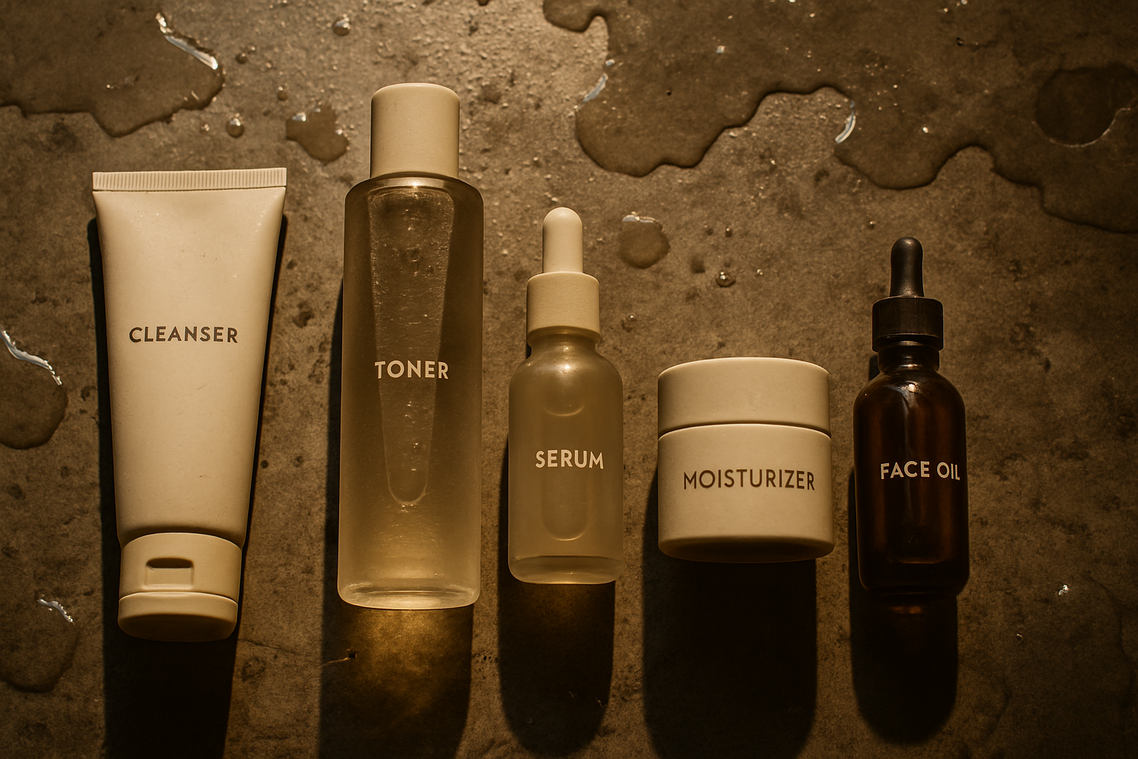
At night, your skin shifts into repair mode. In fact, research shows cell regeneration peaks while you sleep (American Academy of Dermatology). So while you’re binge-watching one more episode, your skin is quietly clocking in for overtime.
“Do I really need a whole routine before bed?” a friend once asked me.
Short answer? Yes—if you want results.
Step 1: Double Cleanse
First, use an oil-based cleanser to dissolve makeup, SPF, and excess sebum (oil produced by your skin). Then follow with a water-based cleanser to remove sweat and debris. Some argue double cleansing is excessive. However, if you wear sunscreen daily—and you should—it ensures a truly clean canvas.
Step 2: Toner or Essence
Next, apply a toner or essence to rebalance pH and hydrate. Think of it as priming a wall before paint (the paint being your serums).
Step 3: Chemical Exfoliants or Retinoids (Treatment)
Here’s the powerhouse step. Apply AHAs (alpha hydroxy acids), BHAs (beta hydroxy acids), or retinoids to clean, dry skin. These ingredients accelerate cell turnover and improve texture. That said, more isn’t better. Alternate nights to avoid irritation. “Start low and go slow,” dermatologists often advise (AAD).
Step 4: Hydrating Serum
After actives absorb, layer a hydrating serum like hyaluronic acid to attract water into the skin. This is essential when learning how to layer skincare products properly.
Step 5: Eye Cream
Choose a richer eye cream at night. The delicate under-eye area benefits from reparative ingredients like peptides.
Step 6: Night Cream
Then, seal it in with a thicker moisturizer to support your skin barrier.
Step 7: Face Oil (Optional)
Finally, press a few drops of face oil on top if you’re dry. It acts as an occlusive (a barrier that locks in moisture).
Still unsure where to start? Read how to build a skincare routine for your skin type: https://janlersont.com/how-to-build-a-skincare-routine-for-your-skin-type/
Because glowing skin rarely happens by accident (even if it looks effortless).
Common Layering Mistakes and Pro Tips
Great skin is often about timing, not just products. Research in the Journal of Cosmetic Dermatology (2016) notes that absorption improves when formulas are layered correctly.
Mistake 1: Not Waiting Between Layers
Give each product 30–60 seconds to absorb. Rushing can dilute actives and reduce efficacy.
Mistake 2: Mixing Incompatible Actives
Using Vitamin C and Retinol together may increase irritation (AAD guidance).
Mistake 3: Applying Oil Too Early
Oils seal moisture—apply last.
| Step | Why It Matters |
|---|---|
| Wait | Better absorption |
| Separate actives | Less irritation |
| Oil last | Locks in hydration |
Pro Tip: Pat, don’t rub. When learning how to layer skincare products, gentle pressing supports absorption and minimizes irritation.
Mastering Your Skincare Sequence for Visible Results
Remember, the secret to visible results is simple: follow the thin-to-thick rule. By understanding how to layer skincare products, you ensure each formula absorbs properly and performs at its best. You’ve taken control of your routine—now put it into action. Start your new layering ritual tonight for healthier, more radiant skin.
 There is a specific skill involved in explaining something clearly — one that is completely separate from actually knowing the subject. Linda Montaguestones has both. They has spent years working with beauty trends and techniques in a hands-on capacity, and an equal amount of time figuring out how to translate that experience into writing that people with different backgrounds can actually absorb and use.
Linda tends to approach complex subjects — Beauty Trends and Techniques, Everyday Beauty Hacks, Makeup Routine Inspirations being good examples — by starting with what the reader already knows, then building outward from there rather than dropping them in the deep end. It sounds like a small thing. In practice it makes a significant difference in whether someone finishes the article or abandons it halfway through. They is also good at knowing when to stop — a surprisingly underrated skill. Some writers bury useful information under so many caveats and qualifications that the point disappears. Linda knows where the point is and gets there without too many detours.
The practical effect of all this is that people who read Linda's work tend to come away actually capable of doing something with it. Not just vaguely informed — actually capable. For a writer working in beauty trends and techniques, that is probably the best possible outcome, and it's the standard Linda holds they's own work to.
There is a specific skill involved in explaining something clearly — one that is completely separate from actually knowing the subject. Linda Montaguestones has both. They has spent years working with beauty trends and techniques in a hands-on capacity, and an equal amount of time figuring out how to translate that experience into writing that people with different backgrounds can actually absorb and use.
Linda tends to approach complex subjects — Beauty Trends and Techniques, Everyday Beauty Hacks, Makeup Routine Inspirations being good examples — by starting with what the reader already knows, then building outward from there rather than dropping them in the deep end. It sounds like a small thing. In practice it makes a significant difference in whether someone finishes the article or abandons it halfway through. They is also good at knowing when to stop — a surprisingly underrated skill. Some writers bury useful information under so many caveats and qualifications that the point disappears. Linda knows where the point is and gets there without too many detours.
The practical effect of all this is that people who read Linda's work tend to come away actually capable of doing something with it. Not just vaguely informed — actually capable. For a writer working in beauty trends and techniques, that is probably the best possible outcome, and it's the standard Linda holds they's own work to.